

The global microbiome dataset has a geography problem
Over the past two decades, human microbiome research has expanded significantly, but Australian gut microbiome diversity remains largely absent from the datasets driving that growth. Large-scale sequencing projects have catalogued microbial communities across the gut, oral cavity, skin and other body sites, generating reference datasets that underpin thousands of downstream studies.
However, these reference datasets are not globally representative. The majority of human microbiome data has been generated from cohorts in North America and Western Europe. Populations from the Asia-Pacific region, including Australia, remain significantly underrepresented.
This creates a meaningful limitation for research. The composition of the human microbiome varies across populations, shaped by diet, geography, ethnicity, antibiotic exposure history and environmental factors. Reference collections built primarily on one population may not generalise well to others.
Population-level variation
What population-level microbiome variation actually means
Microbiome composition is not uniform across human populations and these differences are not superficial.
Studies comparing gut microbiome composition across geographically and ethnically distinct cohorts have identified differences in the abundance of key taxa, overall community diversity and functional gene content. These differences can influence metabolism, immune regulation and disease susceptibility.
For translational research, this has practical implications. Findings generated in one population may not replicate in another if underlying microbiome composition differs. Drug candidates that interact with microbial metabolism, an increasingly important consideration in pharmacology and immuno-oncology, may also perform differently across populations.
Building microbiome research infrastructure anchored in Australian donor diversity is therefore not only a question of completeness. It is a prerequisite for research that is applicable to Australian patients and clinical contexts.
Scope of collection
The body sites that matter
The human microbiome is not a single entity. It includes distinct microbial communities across multiple body sites, each with its own composition and function.
The gut microbiome is the most extensively studied and is linked to metabolic health, immune development and a growing range of disease associations. However, it is not the only site of interest.
- The oral microbiome has been implicated in systemic inflammation, cardiovascular disease and oral cancer.
- The skin microbiome plays a role in barrier function and conditions such as atopic dermatitis.
- The vaginal microbiome is strongly associated with reproductive health outcomes and preterm birth risk.
Each of these ecosystems requires site-specific collection protocols, culture conditions and characterisation approaches. A biobank spanning multiple body sites enables research into cross-site interactions such as the gut–lung and gut–brain axes, which are increasingly important in microbiome science.
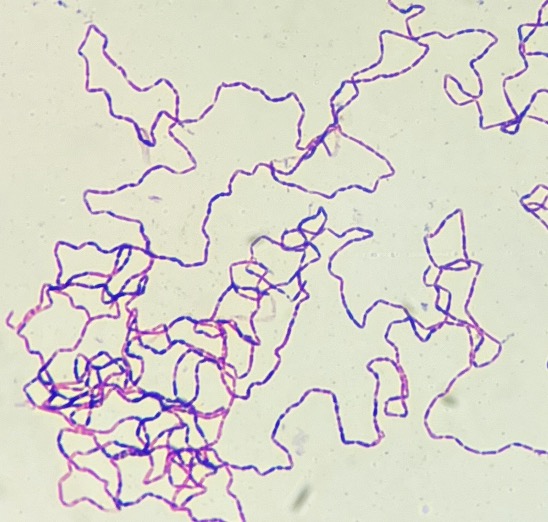
Gram stain microscopy of Mediterraneibacter lactaris, an isolate from the AHMB collection.
Why live isolates are essential
Sequencing has transformed microbiome research but it does not provide functional resolution.
It identifies which organisms are present but does not directly reveal how they metabolise substrates, respond to drugs, interact with host cells or compete within microbial communities.
Answering these questions requires live, cultured isolates. However, obtaining research-grade isolates, particularly for fastidious and anaerobic organisms, remains one of the most persistent bottlenecks in microbiome research.
Well-characterised biobank isolates help address this limitation. When provenance is documented, genomic characterisation is complete and viability is verified, researchers can move from hypothesis to experiment without extended sourcing and validation steps. This improves both research efficiency and reproducibility.
Research impact
What representative biobanking enables
A biobank anchored in Australian donor diversity enables three key areas of research impact.
- It supports population-specific microbiome studies relevant to Australian clinical contexts.
- It contributes geographically distinct data to global comparative studies.
- It enables functional research using live isolates that extend beyond sequencing-based inference.
Importantly, it also strengthens reproducibility. When researchers work from standardised, curated source material, cross-study comparisons become more meaningful and findings are easier to validate.
About AHMB
Where we are building
The Australian Human Microbiome Biobank is developing a collection of human microbiome isolates spanning multiple body sites, with a focus on Australian donor diversity. Each isolate is accompanied by genomic characterisation, verified viability data and donor metadata collected under appropriate ethics frameworks.
Our online catalogue is now live, providing academic and industry researchers with access to browse and request isolates for their research programs.
Building representative microbiome infrastructure is a long-term effort. It begins with recognising the existing gaps and working systematically to address them. The AHMB is operated by the Centre for Microbiome Research at Queensland University of Technology.
Our collection is now live!
Browse and request isolates